Friday, September 24, 2004


Island Royale in pretty good shape. Posted by Hello

These houses are on Old River, again on Perdido Key, Alabama. Posted by Hello

About a 35 foot boat across the road from Cotton Bayou. Posted by Hello

More houses on Perdido Key. Posted by Hello

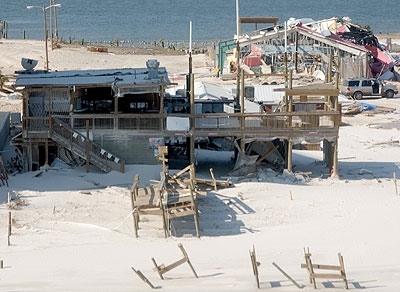
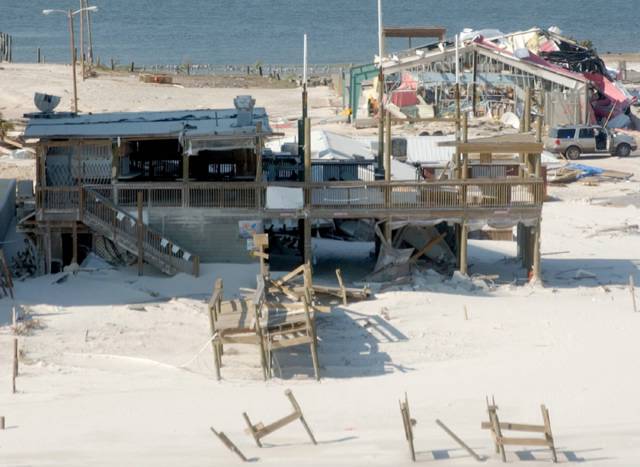
One of the beach houses on Perdido Key, Alabama, gutted by Ivan. Posted by Hello

In the background is what is left of the dry dock storage facility at Zeke's Landing. Most of the boats look ok. Posted by Hello

On the way to the Florida state line, this is Perdido Place, which is similar in construction to Atlantis -- looking good. Posted by Hello

Here is a clearer picture of the Flora-Bama. View is from the Gulf facing north. Water on other side of the road is Old River. Panama Mac's is across the street pass the SUV. I have a condo just east of here in Florida which I hope to visit today for the first time. Will post photos. Posted by Hello

This is the Gulf down West Beach at the bridge/cut for Little Lagoon. Posted by Hello

This is Mikee's, about two blocks north of the beach. Posted by Hello

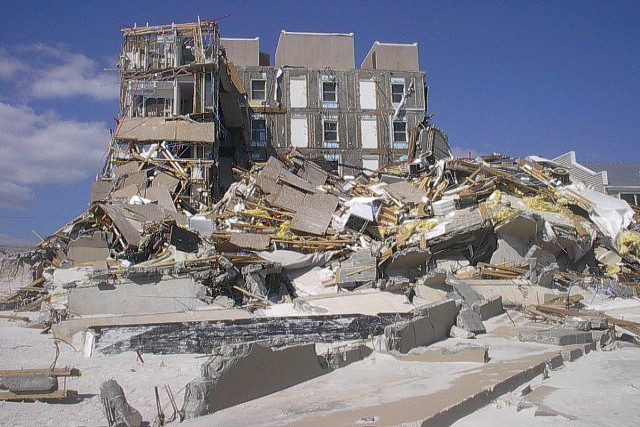
This is the Crystal Beach condo. It is across from Hwy 161 in Orange Beach, about 1 mile south of my place, but on the Gulf itself. Built in the late 90s. I think this is about where the center of Ivan came ashore. Posted by Hello

East Beach Blvd., Gulf Shores Posted by Hello

This is a shot of Sea 'n Suds, which sticks out into the Gulf. Surprisely, it survived the storm. Posted by Hello

In the fore-front is the world famous Pink Pony Pub. It was rebuilt as it is here in 1979 after Frederic. Behind it is the new Phoenix All-Suites condominium which fared the storm well. I suspect that the Pink Pony's days are over. Posted by Hello

This is downtown Gulf Shores, two blocks north of the Gulf of Mexico. Posted by Hello

Thursday, September 23, 2004


Repeat. Posted by Hello

View of the Herbert camphouse from across the bayou. Post Ivan. Posted by Hello

Neighbor was not as lucky as I was. Posted by Hello

Large pine tree in my front yard. Bent then snapped. Posted by Hello

This is view from the back deck of my house on Buck's Bayou facing southeast, right down from Tacky Jack's. The hottub is in retreat. Pool decking is in disarray. Pool is still holding water (and a school of pin fish). Posted by Hello

This is what is left of the Flora-Bama Roadhouse on the Alabama-Florida line. http://www.florabama.comPosted by Hello

Here is my other boat, the Laissez Faire, dangling above the decking around my pool. Posted by Hello

This is my boat, the Loco-Foco, safely resting above what was my dock. Posted by Hello

This is the Beach Road in Gulf Shores, just as you enter the State Park. Posted by Hello

Thursday, August 26, 2004

So Much for Free Speech (washingtonpost.com)

(Site requires free registration.) Robert Samuelson, one of the more thoughtful writers for the Washington Post, cuts to the heart of all the recent chatter about independent campaign activities. Bush, on the other hand, as usual, comes across as completely clueless on the subject.

Tuesday, August 10, 2004

"Under democracy, one party always devotes its chief energies to trying to prove that the other party is unfit to rule – and both commonly succeed, and are right."


- H.L. Mencken

Thursday, August 05, 2004

Novak: Bush employing platform shoos to keep party in line

Take this for what it is worth. Traditionally the Republican platform has been ignored after the convention. Apparently it now is being abandoned prior to the convention. Hubris or just neoconservative realism?

Monday, August 02, 2004

Yahoo! News - Ricky Williams Reportedly Failed Third Drug Test

Wow. Marijuana use cost Ricky $650,000 in fines last year. Another victim of the insane war on drugs (drug-taking people).

Where are the moralists? The clergy? The civil rights crowd?

Tuesday, July 27, 2004

An Echo, Not a Choice

The case for (hold your nose now) Kerry. Actually it is the case for going fishing.

Tuesday, July 20, 2004

Frist's Senate in disarray

Bob Novak reporting on the Greatest Deliberative Body ever.

Thursday, June 24, 2004

Wednesday, June 23, 2004

Who is Uncle Joe?

I have pasted the following anlysis from a blog called The Volokh Conspiracy, which is generally quite good. They have University of Chicago law school professor Cass Sunstein on this week as a guest blogger. Sunstein has a new book coming out which he is promoting. I have changed his recent post by changing the name of his hero. Guess who he is talking about?

"Uncle Joe's speech wasn't elegant. It was messy, sprawling, unruly, a bit of a pastiche, upbeat, and not at all literary. It was the opposite of Lincoln's tight, poetic, elegiac Gettysburg Address. But because of what it said, it has a strong claim to being the greatest speech of the twentieth century.

"Uncle Joe began by emphasizing that the "supreme objective for the future" -- the objective for all nations -- was captured "in one word: Security." Uncle Joe argued that the term "means not only physical security which provides safety from attacks by aggressors," but includes as well "economic security, social security, moral security." Uncle Joe insisted that "essential to peace is a decent standard of living for all individual men and women and children in all nations. Freedom from fear is eternally linked with freedom from want."

"Uncle Joe looked back, and not entirely approvingly, to the framing of the Constitution. At its inception, the nation had grown "under the protection of certain inalienable political rights—among them the right of free speech, free press, free worship, trial by jury, freedom from unreasonable searches and seizures."

"But over time, these rights had proved inadequate. Unlike the Constitution's framers, "we have come to a clear realization of the fact that true individual freedom cannot exist without economic security and independence." As Uncle Joe saw it, "necessitous men are not free men," not least because those who are hungry and jobless "are the stuff out of which dictatorships are made." Recalling the New Deal, he cut to the chase: The nation had "accepted, so to speak, a second Bill of Rights under which a new basis of security and prosperity can be established for all—regardless of station, race, or creed."

"Then he listed the relevant rights:

The right to a useful and remunerative job in the industries or shops or farms or mines of the Nation;

The right to earn enough to provide adequate food and clothing and recreation;

The right of every farmer to raise and sell his products at a return which will give him and his family a decent living;

The right of every businessman, large and small, to trade in an atmosphere of freedom from unfair competition and domination by monopolies at home or abroad;

The right of every family to a decent home;

The right to adequate medical care and the opportunity to achieve and enjoy good health;

The right to adequate protection from the economic fears of old age, sickness, accident, and unemployment;

The right to a good education.
Having catalogued these eight rights, Uncle Joe said that "we must be prepared to move forward, in the implementation of these rights." Uncle Joe asked "the Congress to explore the means for implementing this economic bill of rights—for it is definitely the responsibility of the Congress to do so."

Tuesday, June 22, 2004

Bush to screen population for mental illness

Presumably, this is a joke. Let us see. I plan to be first in line for the screening.

Wednesday, June 16, 2004

Reason

Doherty making major sense on the middle east.
WSJ.com - Freedom's Friend

Friedman on Reagan -- further comments as times allow

Monday, June 07, 2004

Tuesday, May 18, 2004

Rumsfeld may have to ax an ally

Cambone, not Rumsfield, thought it a great idea to abuse innocents.

Sunday, May 16, 2004

The New York Times > Opinion > Op-Ed Contributor: Low Rates, High Expectations

A freebie from Jim Grant. (The subscription for his newsletter goes for $760 per annum.)
Secretary Powell on Meet the Press

Apparently Powell has grown accustomed to lying.

Saturday, May 15, 2004

Thursday, May 13, 2004

VIN SUPRYNOWICZ: Wars on drugs, guns, fathers goi...

Interesting updates on the state of the union.

Monday, May 10, 2004

Few friends rush to aid Rumsfeld

Novak with the latest scoop. Problem is there is every chance there will be no second term for Bush, and the Bush team doesn't know what hit them. On second thought, what a world!

Thursday, May 06, 2004

Iraqi Prisoner Shamed by Experience

No comment needed.

Tuesday, May 04, 2004

How to slash your tax bills

Alan Reynolds on slowing down and enjoying leisure--a good which carries a negative tax rate.

Wednesday, April 14, 2004

The Quotable Bush

The Rev. Bush last night: "My job as the President is to lead this nation into making the world a better place. And that's exactly what we're doing." Who would have known that when Bush rejected "nation building" during his campaign for the presidency, what he really had in mind was remaking and shaping-up the whole world? -- not exactly one of the powers delegated to the federal executive.

Sunday, April 11, 2004

"State Education: A Help or Hindrance?"

by Auberon Herbert (1880)

-- excerpts:

"At present we have one system of education applied to the whole of
England. The local character of school boards deceives us, and makes us
believe that some variety and freedom of action exist. In reality they have
only the power to apply an established system. They must use the same class
of teachers; they must submit to the same inspectors; the children must be
prepared for the same examination, and pass in the same standards. There
are some slight differences, but they are few and of little value. Now, if
any one wishes to realise the full mischief which this uniformity works,
let him think of what would be the result of a uniform method being
established everywhere -- in religion, art, science, or any trade or
profession. Let him remember that canon of Mr. Herbert Spencer, so pregnant
with meaning, that progress is difference. Therefore, if you desire
progress, you must not make it difficult for men to think and act
differently; you must not dull their senses with routine or stamp their
imagination with the official pattern of some great department. If you
desire progress, you must remove all obstacles that impede for each man the
exercise of his reasoning and imaginative faculties in his own way...

A great department must be by the law of its own condition unfavourable to
new ideas. To make a change it must make a revolution. Our Education
Department, for example, cannot issue an edict which applies to certain
school boards and not to others.... Follow still further the awkward
attempts of a department at improvement. Influenced by long-continued
public pressure, or moved by some new mind that has taken direction of it,
it determines to introduce a change, and it issues in consequence a
wholesale edict to its thousands of subordinates. But the conditions
required for the successful application of a new idea are, that it should
be only tentatively applied; that it should be applied by those persons who
have some mental or moral affinity with it, and who in applying it, work
intelligently and with the grain, not mechanically and against the
grain....

If only one wishes to realise why officialism is what it is, let him
imagine himself at the centre of some great department which directs an
operation in every part of the country. Whoever he was he must become
possessed with the idea of perfect regularity and uniformity. His waking
and sleeping thought would be the desire that each wheel should perform in
its own place exactly the same rotation in the same time. His life would
simply become intolerable to him if any of his thousands of wheels began to
show signs of consciousness, and to make independent movements of their
own.

But suppose that a man of fresh mind and personal energy were to be placed
at the head of our Education Department who perceived the mischievous
effect of uniformity, could not this official tendency be counteracted? It
might for a short space of time, just as some muscles of a strong man can
for some hours defeat the pull of gravitation, but gravitation wins in the
end. Such changes would only be spasmodic; they would not be the natural
outcome of the system, and therefore could not last. Moreover, for those
who understand the value of liberty and of responsibility, it is needless
to point out how utterly false the system must be which makes the nation
depend upon the intelligence of a minister, and not upon the free movement
of the different minds within itself....

From boyhood to manhood the teacher himself is undergoing examinations; for
the rest of his life he is reproducing on others what he himself has gone
through. It is needless to say, that the higher aims of the teacher,
methods of arousing the imagination and developing the reasoning powers,
which only bear fruit slowly and cannot be tested by a yearly examination
of an inspector -- whose fly will be waiting at the school door during the
few hours at the disposal of himself or his subordinate -- new attempts to
connect the meaning of what is being learned with life itself, and to
create an interest in work for work's own sake instead of the inspector's
sake, ... all these things must be laid aside as subordinate to the one
great aim of driving large batches successfully through the standards and
making large hauls of public money...

And now, leaving much unsaid, I must ask what practical steps should be
taken by those workmen who suspect that state education is but a part of
that coercive drill which one half the human race delights to inflict upon
the other half. First of all get rid of compulsion. It has been made the
instrument of endless petty persecutions. It is fatal to the free growth of
an intelligent love of education; ...to a true respect of man for man; for
each man's right to judge what is morally best for himself and for those
entrusted to him. It is an attempt to make one of those shortcuts to
progress which end by making the goal recede from us.

...It is a copy of a continental institution, taken from a nation that,
living under a paternal government, has not yet learned to spell the
letters of the word *liberty*. The example of Germany and its highly
organised state education is not alluring. ... Where you subject people to
strong official restraint, you seem fated to produce on the one side
rigidity of thought and pedantry of feeling, on the other side those
violent schemes against the possessions and the personal rights of the rich
which we call socialism. Careful respect for the rights of others, vigorous
and consistent defence of one's own rights, a deeply rooted love of freedom
in thought, word, and action -- these things are simply impossible wherever
you entrust great powers to a government, and allow it to use them not
simply within a sphere of strictly defined rights, but as a supreme judge
of what the momentary convenience requires.

...It is always difficult to introduce freedom into a system that is
founded on authority and officialism."

Excerpts from "State Education: A Help or Hindrance?" *Fortnightly Review*,
1880; in *The Right and Wrong of Compulsion by the State, and other essays*
by Auberon Herbert, Copyright (c) 1978 by Liberty Fund Inc., Indianapolis,
Indiana. ISBN 0-913966-42-8

D.A. Could Be Disbarred Over Drug Prosecutions

This is certainly novel. I thought undercover cops were trained to lie.
Pre-9/11 doings are coming to light

Jim Pinkerton writes: "If you knew that President Franklin D. Roosevelt had received a memo a month before Pearl Harbor entitled, "Japanese Determined to Attack the United States in the Pacific," and that he had done nothing about that information, would that knowledge change your perception of FDR as a wise war leader?

Roosevelt received no such memo, of course, but President George W. Bush got a blunt warning five weeks before 9/11 and he did little or nothing. He even presided over a stand- down in preparations, concentrating on other concerns."

Of course FDR could have written the Peal Harbor memo to himself, as he was determined to bully the Japanese into attacking U.S. bases somewhere in the Pacific.

Wednesday, April 07, 2004

Another Ayatollah

A million mistakes come home to roost:


Sistani’s Shia refuse to play their assigned role.


By Eric S. Margolis


In a remarkable example of historical irony, a scowling, black-turbaned Shia ayatollah has emerged from obscurity for the second time in a quarter century to vex and confound America’s plans for the Mideast.

Twenty-four years ago, the U.S. encouraged Iraq’s ruler, Saddam Hussein, to invade Iran and overthrow the new revolutionary Islamic government of Grand Ayatollah Ruhollah Khomeini. The U.S. and Britain secretly aided Iraq with arms, finance, chemical and biological weapons, intelligence, military advisors, and diplomatic support in its bloody war against Iran that lasted eight years and caused one million casualties. But when Saddam Hussein grew too big for his boots, his former U.S. and British patrons brought him down. Now, over two decades later, another powerful Muslim cleric, Grand Ayatollah Ali el-Sistani, is challenging America’s Mideast Raj, and Washington has reacted to this perfectly predictable event with deep consternation and confusion.

The Bush administration was assured by the neoconservatives who engineered the Iraq War that a co-operative, turban-free regime of pro-U.S. Iraqis would quickly be installed in Baghdad, led by convicted swindler Ahmad Chalabi. However, if Chalabi and his Iraqi National Congress cronies failed, so much the better, went neocon thinking. Their primary objective was to destroy Iraq, not to rebuild it; for Iraq, once the Arab world’s best educated, most industrialized nation, had to be expunged as a potential military and strategic challenge to Israel. So now the U.S. has its own West Bank in Iraq.

In the 1920s, Zionist leader Vladimir Jabotinsky called for Israel to rule “from the Nile to the Euphrates,” as the famous slogan went, by smashing the fragile mosaic of its Arab neighbors into ethnic fragments, then seizing the oil riches of Arabia. So Israel’s far Right and its American neocon fellow travelers are perfectly happy to see Iraq divided de facto into its three component ethnic parts: Shia, Sunni Arab, and Kurd. Better a feeble Iraq broken into weak cantons, like post-1975 Lebanon, than a nation united, even under a U.S.-run regime.

But while Likudniks rejoice at the destruction of their ancient enemy, the United States faces the conundrum of how to forge a seemingly democratic government in Iraq in the face of the nation’s impossible ethnic-religious calculus. Installing a brutal general to run Iraq would be far more convenient. But having found no weapons of mass destruction, the embarrassed Bush administration is now touting creation of democracy as its casus belli and so must go through the motions of democratization.

Enter Grand Ayatollah Sistani. After his rival, Ayatollah Hakim al-Bakr, was blown to bits by a huge bomb, Sistani emerged as the leading voice of Iraq’s Shia. He has so far played a cautious game, urging elections but rejecting calls by his followers for a more overtly anti-American line or armed resistance. Any fair election will give power to Iraq’s Shia, who are 60 percent of the population. If this does not happen, there will be a possible recourse to arms.

Washington has now inherited the identical problem faced by imperial Britain when, in order to control the region’s recently discovered oil, it stitched together three disparate Ottoman vilyats to create the Frankenstein state of Iraq.

Britain, following its usual colonial practice of putting compliant ethnic or religious minorities in power, filled the army, police, and government with Sunni Arabs, who made up only 20 percent of the population. Sunnis ruled Iraq from the 1920s until the U.S. overthrew the regime of Saddam Hussein.

Shia were repressed, often savagely, and economically deprived. Iraq’s ever-rebellious Kurds were kept under control by frequent punitive expeditions and regular bombing of insurgents by the RAF from its main base at Habibanyah. Iraq’s post-1958 regimes followed this practice. Today, U.S. occupation forces in Iraq are also conducting air pacification, this time against rebellious Sunni Arabs.

Interestingly, Britain’s arch-imperialist, Winston Churchill, authorized the RAF to drop poison gas on “primitive tribesmen,” meaning Iraq’s Kurds and Afghanistan’s Pashtun, a fact conveniently forgotten by Tony Blair and George W. Bush when they excoriated Saddam Hussein for “gassing his own people.”

Having been excluded from political power, Iraq’s well-organized Shia are understandably clamoring for empowerment. Most, though not all, appear to desire what they call Islamic democracy: an Iranian-style combination of elective and consultative assemblies with strong checks and balances, overseen by a supreme religious leader—Grand Ayatollah Sistani.

For Washington, which seeks to run Iraq through a small group of handpicked satraps, an Islamic government is anathema. But the Bush administration is very eager to proclaim some sort of “democratic” Iraqi government after a “handover of power” next June—in time for U.S. fall elections.

U.S. proconsul Paul Bremer’s attempt to cobble together a Rube Goldberg system of political caucuses designed to check Shia power, assure Sunni, Kurd, and Turkoman minority rights, and keep the regime under U.S. control, has failed. Ayatollah Sistani has rejected this clumsy, unworkable plan and calls for direct elections as soon as possible. UN advisors, brought in by the U.S. in an effort to paper over differences with the Shia, have backed Sistani’s call for direct elections. Ironically, after proclaiming the dawn of democracy in Iraq, the U.S. is now trying to block direct elections, thwart any form of Islamic government, and deny office to Iraqis opposed to U.S. occupation.

At the same time, Iraq’s Kurds, who now have two virtually independent mini-states in the north, are determined to create an independent nation in northern Iraq that controls the rich Kirkuk oilfields. They are dead set against losing their newfound political and economic autonomy and refuse to place themselves under either Shia or Sunni Arab rule. And having waged a bloody, two-decade struggle against their own independence-seeking Kurds, the increasingly angry Turks are not about to countenance the emergence of a Kurdish state right across the border that controls major oil fields that once belonged to the Ottoman Empire. But Kurds are America’s closest allies in Iraq, and their voices ring loud in Washington. While Kurds may agree to pay lip service to some powerless national body in Baghdad, they are unlikely to cede political rights or control of customs and oil revenues or to cease driving ethnic Arabs from the northern regions. They may also fall to tribal feuding at any time, as so often in their past.

This leaves the Sunni Arabs, who are waging a robust insurgency against occupation forces. A new cadre of Sunni Arab nationalist leaders is emerging in the anti-U.S. underground, in tandem with small but lethal numbers of militant Islamic jihadists. They, not the old, discredited Ba’ath Party, will challenge U.S. rule of Iraq. If the insurgency continues—and it shows no signs of abating—Iraq could become a second Afghanistan, an incubator for a new generation of anti-Western militants from across the Muslim World.

A resolution to Iraq’s ethnic problems defies easy answers. A Swiss-style system, with a weak central government and powerful cantons, is probably the best solution. But long-term, Iraq’s dissolution into three nations may be inevitable.

Meanwhile, the Bush administration is faced with a basic contradiction between its claims of forging a truly democratic Iraq and U.S. strategic ambitions in the region. A free vote in Iraq will produce a Shia-dominated government sympathetic to neighboring Iran. And the ultimate test of any genuine democracy in Iraq will be its ability to order U.S. forces out of Iraq, something the Bush administration will not allow.

The Pentagon plans three major military bases in Iraq from which to control the oil-producing Mideast and to protect the new “Imperial Lifeline,” the pipelines bringing crude westward from the Caspian Basin. Britain used Iraq for the same purpose. In all but name, the U.S. has become heir of the old British Empire.

Washington wants a compliant regime of Iraqi yes-men, what Algerians used to call, “beni oui-ouis,” running internal affairs under the stern gaze of American garrison troops, who will intervene, like the British imperialists, whenever the locals get out of hand or Iraqi politicians grow too independent-minded.

But Ayatollah Sistani and the Shia will not accept a Vichy Iraqi government that excludes them from running Iraq’s foreign and domestic affairs, though that is precisely what Washington plans in June when it “hands over power to Iraqis”—most likely by expanding the existing U.S.-appointed Governing Council of Iraqi collaborators or by staging a rigged national tribal assembly, as was done in Afghanistan. Unfortunately for the Bush administration, it has not yet located in Iraq a glib figurehead like former CIA “asset” in Afghanistan, Hamid Karzai.

So Iraq’s Shia will likely find themselves on a collision course with the U.S. occupation. Younger Shi’ites may disregard their elders’ calls for caution and, not to be outdone by their Sunni rivals, take up arms. If this happens, the current insurgency in the Sunni Triangle (actually a rectangle) will appear modest by comparison. In fact, as Shia anger and frustration surge, Iraq is increasingly resembling Lebanon during its long civil war, and there appears an inexorable slide towards both a wider insurgency and inter-ethnic strife.

What should the U.S. do? The most sensible course: hand Iraq to the UN and pull out. This would produce intense neocon wailing about loss of credibility and giving in to terrorism. But in fact, the longer the U.S. stays in Iraq, the more credibility it loses, and the more it stokes terrorism.

If a total pullout is not in the cards, then the best option is to co-operate with Iraq’s Shia majority and show that the U.S. can work fruitfully with an Islamic regime. Co-operation with Islamists in Baghdad opens the way to good relations with Tehran and a major lessening of anti-American feelings across the Muslim World. But of course, the neocons will do their best to thwart such détente.

The United States has not enough men, treasure, nor intellectual energy to struggle through the morass of Mesopotamian politics and ethnic strife. Governments can usually only think of two or three things at a time, and the mess in Iraq should not be one of them. Otherwise, it will come to bedevil us and sap our energies, just as Iran did in the late 1970s and ’80s. Unless we learn from our errors and work to co-operate with the latest problematic mullah, Ayatollah Sistani, he could well be come the nemesis his predecessor, Imam Khomeini, did just two decades ago.
___________________________________________________


Eric S. Margolis is the author of War at the Top of the World: The Struggle for Afghanistan and Asia and a columnist, commentator, and war correspondent.

March 29, 2004 issue
Copyright © 2004 The American Conservative

Tuesday, April 06, 2004

Refusal by justices thwarts developer

More on the Wetlands issue, and the Supreme Court's failure to clarify the law. Notice the remarks of the local mealy-mouth statist:

Local conservation groups, such as Wetlands Watch, feared that the Supreme Court would rule in favor of Newdunn, giving developers a "free-for-all" to destroy wetlands, said John Blandin, the group's president. Wetlands are never truly isolated, Blandin said, because they connect to other waters via groundwater.

"Wetlands should be protected," he said, "and the Corps should have jurisdiction."


He likes wetlands on other people's property and thinks they should be protected. Therefore, the Feds should have jurisdiction, the Constitution, the statute, and the intention of Congress to the contrary notwithstanding.

Monday, April 05, 2004

Private Guards Repel Attack on U.S. Headquarters (washingtonpost.com)
'Highway' pork: No rep left behind

How sick is this? Of course, the Orange Beach anti-market crowd (along with the "pro-market crowd") gets its bicycle paths, etc., out of the highway appropriations, supposedly financed from the federal excise taxes on tires and gas. It is, of course, the case that the so-called transportation trust fund, always being in hugh "surplus," is being used -- "borrowed" -- to fund the welfare-warfare state.

Meanwhile, the interstate highways rot into disrepair.
More Class Action Abuse

Lawyers took home 10 times more than their clients in a $350 million settlement with AT&T and Lucent Technologies Inc. that ended a class-action suit in Madison County, according to figures provided recently by Lucent.

The lawyers who filed the case said at one point that they represented about 29 million people who had leased telephones from the companies for far more than it would have cost to buy them. But only about 92,000 class members made claims, collecting a total of $8.4 million, said John Skalko, a spokesman for Lucent.

Meanwhile, the 44 lawyers from four firms who pursued the class action in Madison County Circuit Court got $84.5 million in fees and expenses.
Some Doctors Turn to Cash-Only Policies

Just like we do it in my practice! A professional and a client--no third party payor dictating the relationship.
Supreme Court Sidesteps Wetlands Disputes (washingtonpost.com)

The Supremes refuse to enforce their own previous interpretation of the Clean Water Act and how it can be applied to so-called wet-lands (a term nowhere to be found in the statute). So now, given the Supreme Court's refusal to follow up on its 2001 decision about a gravel pit in Illinois, apparently -- at least in those circuits -- every man's property is actually part of the "waters of the United States."

Update from the New York Times:

Without comment, the court turned down three cases challenging federal regulatory power over wetlands that are not directly connected to navigable waterways. Landowners, supported by the building industry, contested the government's interpretation of the Clean Water Act in light of a 2001 Supreme Court decision that rejected federal jurisdiction over isolated ponds visited by migratory birds.

According to the Environmental Protection Agency and the Army Corps of Engineers, that decision was a narrow one that did not remove federal jurisdiction over wetlands that are part of the drainage area or tributary systems of navigable waterways. The plaintiffs and their allies pressed for a broader interpretation of the 2001 ruling.

One, John A. Rapanos, a Michigan landowner who acted without a permit to fill wetlands that were 20 miles from a navigable river, was criminally convicted and now faces a 10-month prison sentence. His appeal was Rapanos v. United States, No. 03-929. The others were Deaton v. United States, No. 03-701, and Newdunn Associates v. United States Army Corps of Engineers, No. 03-637.

Friday, March 26, 2004

Counterterrorism (by Government) is Impossible

At last the topic of 9-11 has shifted onto productive ground. Thanks to the efforts of former counterterrorism official Richard Clarke, some thought is being put into the government failures behind the attacks. "Your government failed you," he says. Precisely, and in many more ways than he or anyone else at these hearings is willing to say.

Here is the problem. The core failure goes way beyond anything the current government managers—however inept, distracted, or corrupt—can correct. If you tell your dog to make you dinner, for example, you can observe later that the dog failed to do so, and have great regrets about this. But what you learn from this experience and how you proceed are the crucial questions. Does the dog need better tools, more scoldings, and a professional trainer? Better to observe that the dog is not the right one for the job. In the same way, the government is not the right one for the job of providing security for the American people.


The lesson of 9-11 is this: the government cannot protect us. No changes in policy as recommended by a commission or by current or ex-government officials are going to change that.

The conclusion of the commission investigating the policies leading up to 9-11 will be the same as from every government commission: a recommendation that the government should have done more and should do more in the future. Both Clarke and his critics presume that the war on terrorism is something that the government can fight, and the debate is over whether the government had done enough prior to 9-11 to sort through intelligence findings, name al Qaeda as the key problem, and anticipate the attacks.
Bush's critics are thrilled to hear Clarke restate what has long been known: the Bush administration was obsessed with Iraq to the exclusion of the radical Islamic threat.

There can be no question about this administration's Iraq fixation. The Bush regime had it in for Iraq for a whole range of reasons, from personal vendettas to oil to regional political issues and probably a few others we are not privy to. It certainly cries out for explanation why this poor country, ruled by a man the US had long backed, suffering under sanctions for a decade after an unjustified war, should be invaded and occupied even though it represented no threat to the US.

Clarke believes Iraq was a distraction, and he is surely right. He also believes that more should have been done sooner to counter genuine terrorist threats, that the attacks on Afghanistan should have taken place earlier, that Bin Laden should have been taken out earlier, that the military and the spooks should have taken more liberties in zapping the bad guys before the bad guys zapped us.

The solution implied in this approach is something no American should favor. It implies not less warmongering but merely a different form of imperialism, focused on one country instead of another, this set of intelligence data instead of that, while not even addressing the question of why the US might be the subject of attacks at all. It is even possible that more Clarkeian-style counterterrorism would have inspired more attacks sooner, but we'll never know since there are no controlled experiments in the relationship between politics and the real world.


How do corporations deal with the problem of information overload? They rely on market signaling and the decentralized planning of millions of private individuals to provide guidance.
And despite all the partisan wrangling about the Clarke message and the hearings in general, the upshot is a message that perfectly accords with something that every bureaucrat and politician wants to hear: that government needs a freer hand, that it did not do enough, that it needs more resources, that it should not be hamstrung in any way. What are government commissions for, except to announce such findings and create a cover for Congress and the White House (whoever happens to occupy it) to demand ever more money and power?
The real question to ask is whether it could have been any other way. Say the US has killed Bin Laden. Cheney is of course correct that this would not have prevented 9-11. Even if it had, there would have been other attacks of a different sort. Or say the US had entirely destroyed Al Qaeda (whatever that would mean): Albright is correct that the ideology behind Al Qaeda's existence is still everywhere to be found because it represents not a peculiar conspiracy by a few, but a response to US policy in general.

The government can spend many years and billions of dollars preventing attacks that have already occurred by doing things it might have wished it had done years or decades ago. But note that there has been no discussion at all of the actual policies that everyone knows inspired the attacks and made them easier to carry out.

Just to mention a few: the stationing of troops in Saudi Arabia, the sanctions against Iraq, the continuing intervention in the ever-lasting Israel-Palestine conflict, the propping up of secular dictatorships all over the Arab world, the raising up and funding of Islamic radicals to counter Soviet influence in Afghanistan, and the regulatory prohibitions in the US against permitting airlines to manage their own security issues. The US government cannot pursue all these policies and then react in shock when it turns out that some people exploit them with violent intent.

Many observers of these policies predicted that something along these lines would take place. You don't need to be a "counterterrorism" bureaucrat to see it. The response to the events of 9-11 around the world was very telling. While the world felt awful for America, most everyone (except Americans) believed that something like this was inevitable. As for who was responsible, the enemies of the US have become countless. The government's response was to make ever more enemies, which is what the recent US policy in Iraq has done.

In other words, the only real way to prevent terrorism is to do less in the way of government policy and more in the way of private provision and trade, which would be far easier to do if the warfare state would stop fomenting trouble all around the world.

How can the market provide security? This gets us into another huge area, and nothing I could write in a column would fully convince anyone of such a radical thesis, so let me merely refer you to the book, The Myth of National Defense, edited by Hans-Hermann Hoppe, which shows that security is not a unique good that must be provided by the state (even if you don't own it, there is no good excuse not to read it).

Let me mention just one issue that has impressed many people who are following the hearings: that of information overload. There are so many bits of intelligence data that are flying in and out of government offices, how can policy makers possibly assess the relative seriousness of various threats much less prepare coherent responses to them?

Contrary to what the government implies, this is not a problem unique to the public sector. A typical multinational corporation faces an information problem just as serious: data flying from every country concerning a million different topics and conditions, every one of which could have a profound effect on profitability the very day it is received.

How do corporations deal with the problem of information overload? They rely on market signaling and the decentralized planning of millions of private individuals to provide guidance, and they depend heavily on the minute-by-minute feedback mechanism as provided by prices. The government has no such institutions at its disposal, neither to convey information, nor assess its accuracy, nor provide ongoing feedback on how it responds to conditions.

The lesson we should take from 9-11 is that the government cannot protect us. It is utterly inept, and no changes in policy as recommended by a commission or present or ex-government officials are going to change that.

----

Llewellyn H. Rockwell, Jr. [rockwell@mises.org] is president of the Ludwig von Mises Institute in Auburn, Alabama, and editor of LewRockwell.com. He is the author of Speaking of Liberty. Comment on this article on the blog.


Tuesday, March 23, 2004

I'll Never Retire

We baby boomers may as well get used to the proposition that our life's work will not end in the type of retirement that we see the "Greatest Generation" has arranged for itself. But that is not so bad.

Monday, March 22, 2004

The financial system and the global recovery: what lies ahead? (BIS Speeches 18 Mar 2004)
Toronto Sun Columnist: Eric Margolis: "Ex-KGB men tighten their grip on Russia "
Is Anybody in Charge?- by Justin Raimondo: "Is Anybody in Charge?
Former anti-terrorism adviser Richard Clarke exposes White House's criminal negligence "

Monday, March 08, 2004

Bruce Bartlett: Outsourcing reality

"There is a growing backlash against outsourcing--sending domestic work to foreign businesses--that erupted in the Senate last week, where anti-outsourcing legislation was adopted on a 70 to 26 vote. Opponents of outsourcing cheered, but investors are becoming aware that these actions threaten profits and stock prices."

Thursday, February 12, 2004

Too easily persuaded into an unnecessary war

Here is an interesting take: Bush ran against nation building and foreign adventurism, but then hired the same old crowd that had worked for his father.

Wednesday, February 11, 2004

Scalia Defends Hunting Trip With Cheney

Scalia is not one to be intimdated by the typical media attempt to push him around.

Wednesday, February 04, 2004

Bush's Budget Director Treated for Smoke Inhalation

(2004-02-03) -- White House budget director Joshua B. Bolton was briefly hospitalized today and treated for smoke inhalation and lacerations after a freak accident involving the Bush administration's $2.4 trillion budget proposal for 2005.

"Mr. Bolton was preparing to do a presentation about the budget when he was overcome by the smoke, fainted and actually shattered one of the mirrors which cut him in several places," said an unnamed senior administration official. "We're still working to confirm rumors that Mr. Bolton may have been juggling chainsaws at the time."

Mr. Bolton had been preparing to explain to Republican lawmakers how President Bush's budget adheres to the conservative values of smaller government and fiscal restraint.

The 2005 budget proposal projects a $521 billion deficit, with spending increases for the departments of Defense, Education, Energy, Health and Human Services, Homeland Security, Housing and Urban Development, Interior, Justice, Labor, State, the Veterans Administration and the IRS. The expenses of war in Afghanistan and Iraq are not included in the $2.4 trillion total, and neither is the Homeland Security department's $2.5 billion Project BioShield.

Monday, February 02, 2004

Jude Wanniski's Take: Trent Lott Promised a Smoking Gun

He also cites a July 2002 Washington Post story that lays out what everyone who was paying attention at the time knew: Iraq was no immediate threat to anybody:

Despite President Bush's repeated bellicose statements about Iraq, many senior U.S. military officers contend that President Saddam Hussein poses no immediate threat and that the United States should continue its policy of containment rather than invade Iraq to force a change of leadership in Baghdad.

The conclusion, which is based in part on intelligence assessments of the state of Hussein's nuclear, chemical and biological weapons programs and his missile delivery capabilities, is increasing tensions in the administration over Iraqi policy.

The cautious approach -- held by some top generals and admirals in the military establishment, including members of the Joint Chiefs of Staff -- is shaping the administration's consideration of war plans for Iraq, which are being drafted at the direction of Bush and Defense Secretary Donald H. Rumsfeld.

The senior officers' position -- that the risks of dropping a successful containment policy for a more aggressive military campaign are so great that it would be unwise to do so -- was made clear in the course of several interviews with officials inside and outside the Pentagon.

High-level civilians in the White House and Pentagon vehemently disagree. They contend that Hussein is still acting aggressively, is intimidating his neighbors and is eager to pursue weapons of mass destruction and the means to deliver them.

These officials say time is not on the side of the United States. "The whole question is, how long do you wait with Saddam Hussein in possession of the capabilities he has and would like to have?" said Richard N. Perle, head of the Defense Policy Board, a Pentagon advisory group.

Tuesday, January 27, 2004

Monday, January 26, 2004

New York Times: Education Is No Protection

Bob Herbert has discovered "offshore outsourcing." Amazing. What has Paul Craig Roberts wrought?

Saturday, January 24, 2004

Making Sense on Marijuana

James Jackson Kilpatrick exposes Ascroft for the jerk that he is.
What's Wrong with the Democrats

You may have to scroll down to 1-24.
City Journal Winter 2004 | The ADA Shakedown Racket by Walter K. Olson

An unconstitutional federal statute wreeks much havoc.

Friday, January 23, 2004

Will George Soros Panic the Market?

Place your bets. I bet "no." Read his stuff.

Monday, January 19, 2004

Star Parker: Reflections on Martin Luther King

"Civil rights movement" trumped by the Welfare State? Actually, the original civil rights movement was ended by the Supreme Court's refusal to enforce the "privileges or immunities" clause of the 14th amendment. "No State shall make or enforce any law which shall abridge the privileges or immunities of citizens of the United States." Supposedly made a part of the Constitution in 1868, this clause was shamelessly declared a dead letter by the Supreme Court (in a 5-4 decision) in the Slaughter-House Cases rendered in 1870. Suffice it to state that the "police powers" of the States have been enormously expanded since that date -- in spite of an explicit bar to their expansion.

Sunday, January 18, 2004

The Demonized Seed

As a Recreational Drug, Industrial Hemp Packs the Same Wallop as Zucchini. So Why Does the U.S. Drug Enforcement Agency Continue to Deny America This Potent Resource? Call It Reefer Madness.

Call it Crazy. Call it typical statist behavior.

Monday, January 12, 2004

APP.COM - High time to change strategy in drug war

As a child growing up in a period when the Jim Crow South was under increasing pressure from Northern moralists and the Eastern media, I was always curious why the moral leadership of the South -- such as local ministers and business leaders -- did not step up to the plate and offer the black population its due: voting rights, desegregation of truly public places such as the government schools, and peace from the tyranny of the local police powers.

Similar moral issues are involved in the "war on drugs." Why is it that local religious leaders, the press -- which is normally so willing to being "progressive", and others in position to have influence -- and the obligation -- are unwilling to point out the corrupt, insidious, and ugly nature of this program? It is an obvious fact that the feds are corrupting the local police authorities with their federal grants and so forth; the effect is to turn the local police into a subsidiary of the federal authorities. Where is the opposition from the local leadership? Is it not clearly wrong to lock up non-rights-violating persons? Why is moral blindness such that otherwise reasonable people claim to think to the contrary?

Thursday, January 08, 2004

MSNBC - No proof links Iraq, al-Qaida, Powell says

No proof; but who cares? Once one has grabbed a tiger by the tail, second guessing by others is not appreciated.
Arms Search: U.S. Withdraws a Team of Weapons Hunters From Iraq

What? Can this be true? Why is it that the phrase "pretext for war" is a pretty standard part of the language?

Thursday, January 01, 2004

The Ditches of Wonderland

Another great piece by James Jackson Kilpatrick, this one on the refusal of Federal courts to reign in the Corps of Engineers and its nonsensical -- and unconstitutional -- interpretation of its wetlands regulatory authority.
Happy New Year

She [America] has abstained from interference in the concerns of others, even when conflict has been for principles to which she clings, as to the last vital drop that visits the heart. She has seen that probably for centuries to come, all the contests of that Aceldama the European world, will be contests of inveterate power, and emerging right. Wherever the standard of freedom and Independence has been or shall be unfurled, there will her heart, her benedictions and her prayers be. But she goes not abroad, in search of monsters to destroy. She is the well-wisher to the freedom and independence of all. She is the champion and vindicator only of her own. She will commend the general cause by the countenance of her voice, and the benignant sympathy of her example. She well knows that by once enlisting under other banners than her own, were they even the banners of foreign independence, she would involve herself beyond the power of extrication, in all the wars of interest and intrigue, of individual avarice, envy, and ambition, which assume the colors and usurp the standard of freedom. The fundamental maxims of her policy would insensibly change from liberty to force.... She might become the dictatress of the world. She would be no longer the ruler of her own spirit.... [America’s] glory is not dominion, but liberty.

John Quincy Adams, 1821


Wednesday, December 31, 2003

Blair 'Knew Iraq Had No WMD'

Of course, Blair -- and Bush -- knew they were making a phony case. And one is hard pressed to find a war that was not similarly contrived.

Tuesday, December 30, 2003

QUANDOQUE BONUS DORMITAT HOMERUS! YOU BET

If you are not keeping up with the continued writings of James Jackson Kilpatrick, you are missing out on a real treat. Jackson, of course, is the author of The Sovereign States, Notes of a Citizen of Virginia, a classic of your editor's youth.
Jim Bradley, knowledgeable on the Austrian theory of Business Cycles, predicts Inflation Now, Deflation Later

I don't think he means deflation in any literal sense, just a credit contraction. Check out the prudentbear.com website.

Friday, December 26, 2003

To Your Health--Tax-free Health Savings Accounts

John Goodman finds a silver lining in the Medicare legislative debacle. I will look into this further and get back.

Thursday, December 25, 2003

The Story Behind the All Night Medicare Vote

Stephen Moore's first-hand account of the Bush Administration's duplicity in the medicare debacle concludes:

"I really believe that if we could have won this vote against the most powerfulwhip operation in the history of House and a popular Republican president, it would have been a shot across the bow at the Republican establishment that conservatives are sick of the spending splurge that is going on inside Washington these last few years. The budget has grown by 27% in two years a faster rate of growth in the budget than at anytime since LBJ’s presidency. Republican leaders in the White House and the Congress seem entirely unconcerned about the orgy of spending and debt. They are in denial. A deserved defeat of this bill would have dropped an ice cold bucket of water on their heads and helped them snap out of it. So close!

"I’m convinced this is a phyric victory for the Republican party bosses. The bill could blow up in the Republicans’ laps when seniors see the details of the carved up turkey they’ve just been served. Worse, the bill threatens to further demoralize fiscal conservative voters who are infuriated by the GOP’s massive expansion of government. I know I’m demoralized. As Mike Pence told me last week, “We Republicans seem to have forgotten who we are and why voters sent us here.”

We now have two big government parties in Washington. And we only have 25 Republicans in the House and 4 in the Senate who are trying to pull the Republicans in an anti-big government direction."

That sounds like things are about as bad for (small government) Republicans as the year 1935 as the fascist New Deal steamroller went full bore. And Bush's domestic policy reeks of the me-tooism of an Alf Landon, the original progressive, compassionate conservative.
Expert Warned That Mad Cow Was Imminent

The New York Times story (free registration) starts out as a slam on the USDA for failing to take the mad cow disease sufficiently serious (actually the re-write guy trys to lay it on the administration rather than the careerists, but we know who runs things). Thereafter, the story gives some interesting facts. Conclusion: Eat veal and avoid processed ground beef products.
No limits for House appropriators who pile on pork

Novak reports on business as usual in Washington DC, as our public servants rob the country in order to drive us all into the poor house. Where even the most junior back-bencher learns the first rule of the Potomac: One must go along to get along.

Wednesday, December 24, 2003

Court Backs IRS Political Disclosure Law

Tax exempt="tax subsidy." To not be taxed is to be subsidized. If you want to assert your 1st Amendment rights, you may be required to give up your "subsidy." Clear enough?

A federal appeals court has upheld a law requiring some nonprofit political groups to report contributions and expenditures to the IRS, saying the Constitution does not guarantee what amounts to a tax subsidy.

"Congress has enacted no barrier to the exercise of the (political groups') constitutional rights," the court wrote. "Rather, Congress has established certain requirements that must be followed in order to claim the benefit of a public tax subsidy."
Billionaire Soros, Independent Groups Target Bush

These are the target groups whose 1st amendment rights are going to go through the wringer.
Court Blocks Changes to Clean Air Act:

A federal appeals court on Wednesday blocked new Bush administration changes to the Clean Air Act from going into effect, in a challenge from state attorneys general and cities that argued they would harm the environment and public health.
The rule would have made it easier for utilities, refineries and other industrial facilities to make repairs in the name of routine maintenance without installing additional pollution controls. And people wonder why the US has blackouts. As companies defer maintenance, the actual consequence of the delay -- or denial of the rulemaking -- will lead to dirtier air.
The George W. Bush - Libertymeter

With the passage of the Drug Benefit boondoggle, wrapping up the complete socialization of health care for those over 64 -- or rather the socialization of benefits, the profits remain, temporarily, private, the Liberty Meter drops 2 more points to the Left.


Tuesday, December 23, 2003

FEC Leader: Political Groups Face Limits (washingtonpost.com)

AP wire story, quoting the incoming Republican chairman, suggests that the Federal Election Commission may assert its jurisdiction over any organization or group which attempts to influence a federal election. And under the O'Connor ruling there is no longer a "bright line" between explicitly advocating the election or defeat of a candidate and mere commenting on current issues -- the mere comment can be construed as attempting to influence the election.

Thus, any such group would be automatically characterized as a PAC (political action committee) and would be subject to the rules, contributuion limits ($5000), reporting requirements, and regulations of the FEC.

What hath O'Connor wrought?


The Supreme Court's Double Standard

Nat Hentoff sums up the Supreme Court's anti-Free Speech decision of the so-called Bipartisan Election Reform Act. That's twice in a month or so that Sandra Day O'Connor has joined with the predictable left-statists to change the course of political history by a 5-4 margin. The other case, involving the Court's approval of racial preferences, is probably the more far-reaching in a negative way as it promises to promote animosity and back-lash reactions among those who perceive they are being wronged by these policies.
The Bush Betrayal

According to David Boaz of Cato, "Federal spending has increased 23.7 percent since Bush took office. Education has been further federalized in the No Child Left Behind Act. Bush pulled out all the stops to get Republicans in Congress to create the biggest new entitlement program -- prescription drug coverage under Medicare -- in 40 years.

"He pushed an energy bill that my colleague Jerry Taylor described as "three parts corporate welfare and one part cynical politics . . . a smorgasbord of handouts and subsidies for virtually every energy lobby in Washington."

"It's a far cry from the less-government, "leave us alone" conservatism of Ronald Reagan."

Sunday, December 21, 2003

In Court v. Congress, Justices Concede One (washingtonpost.com) (This link probably requires free registration.)

"Legal realist" Cass Sunstein gets it all wrong about the "Bipartisan Campaign Reform Act of 2002" and the Supreme Court. In the first place, both Congress and President Bush were on public record as being (at best) indifferent as to the act's constitutionality, so the idea of giving any "deference" to their so-called judgment in passing and signing the legislation is completely misplaced.

Friday, December 19, 2003

Randy E. Barnett on Raich v. Aschroft on National Review Online The 9th Circuit has ruled that the Commerce Clause does not extend to medical merijuana grown privately and not intended to be sold. A modest victory for the principle of federalism.